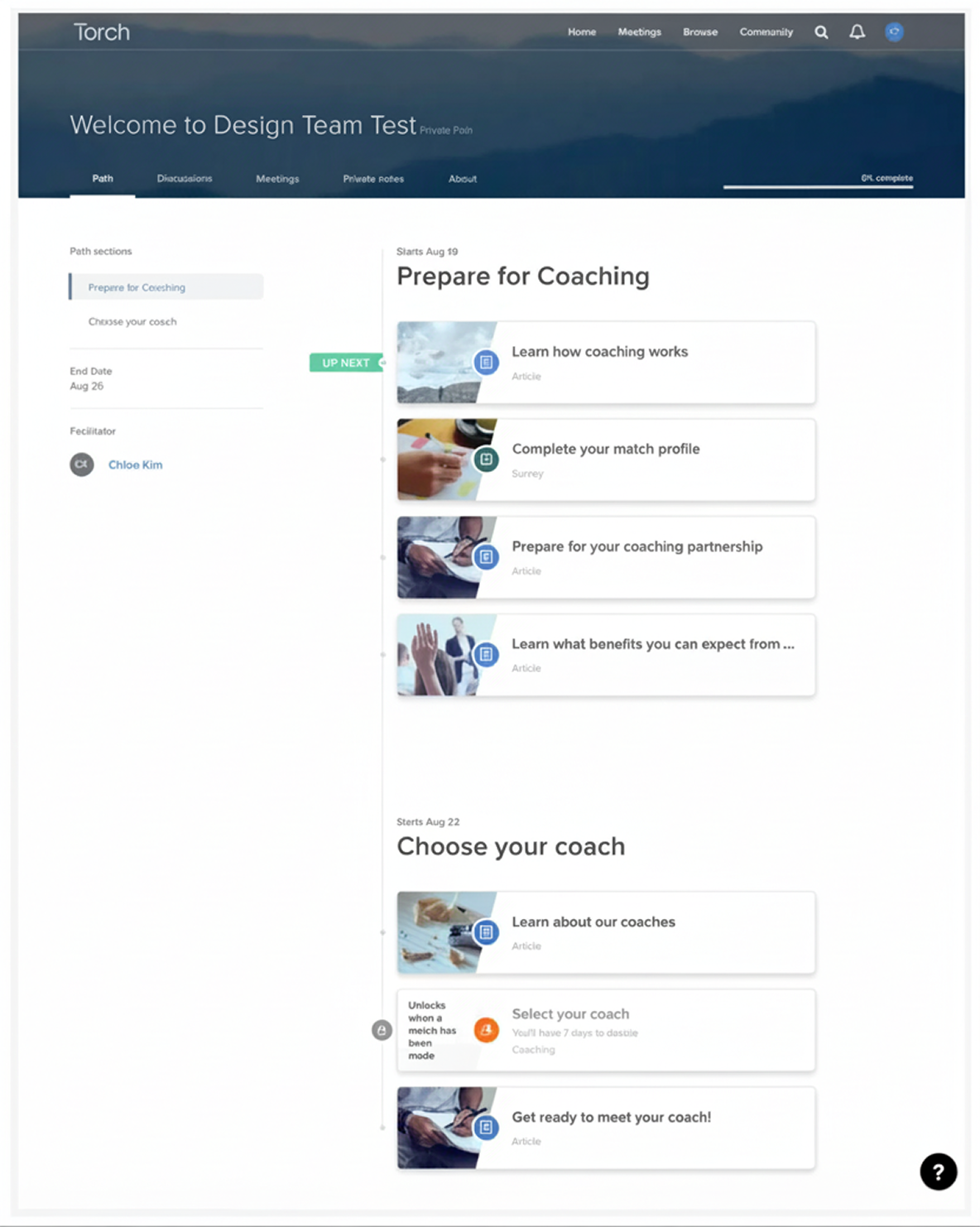
Employees waited 1–2 weeks to get matched with a coach
New coachees were dropped into the product the moment they signed up, with little to no onboarding.
By the numbers
Match profile completion
1–2 weeks
Guidance at signup
No context
Target goal
48 hrs
time to complete, down from 1–2 weeks
What did I do
A strategic onboarding flow from selection to matching
01 · Audit
I co-led research across a full 6-month coaching engagement, for coaches and coachees.
02 · Prioritize
My synthesis surfaced product onboarding as the most critical pain point.
03 · Design
With stakeholders, I built a flow explaining why coachees were selected and what to do next.
At a glance
Before
Dropped into ambiguity
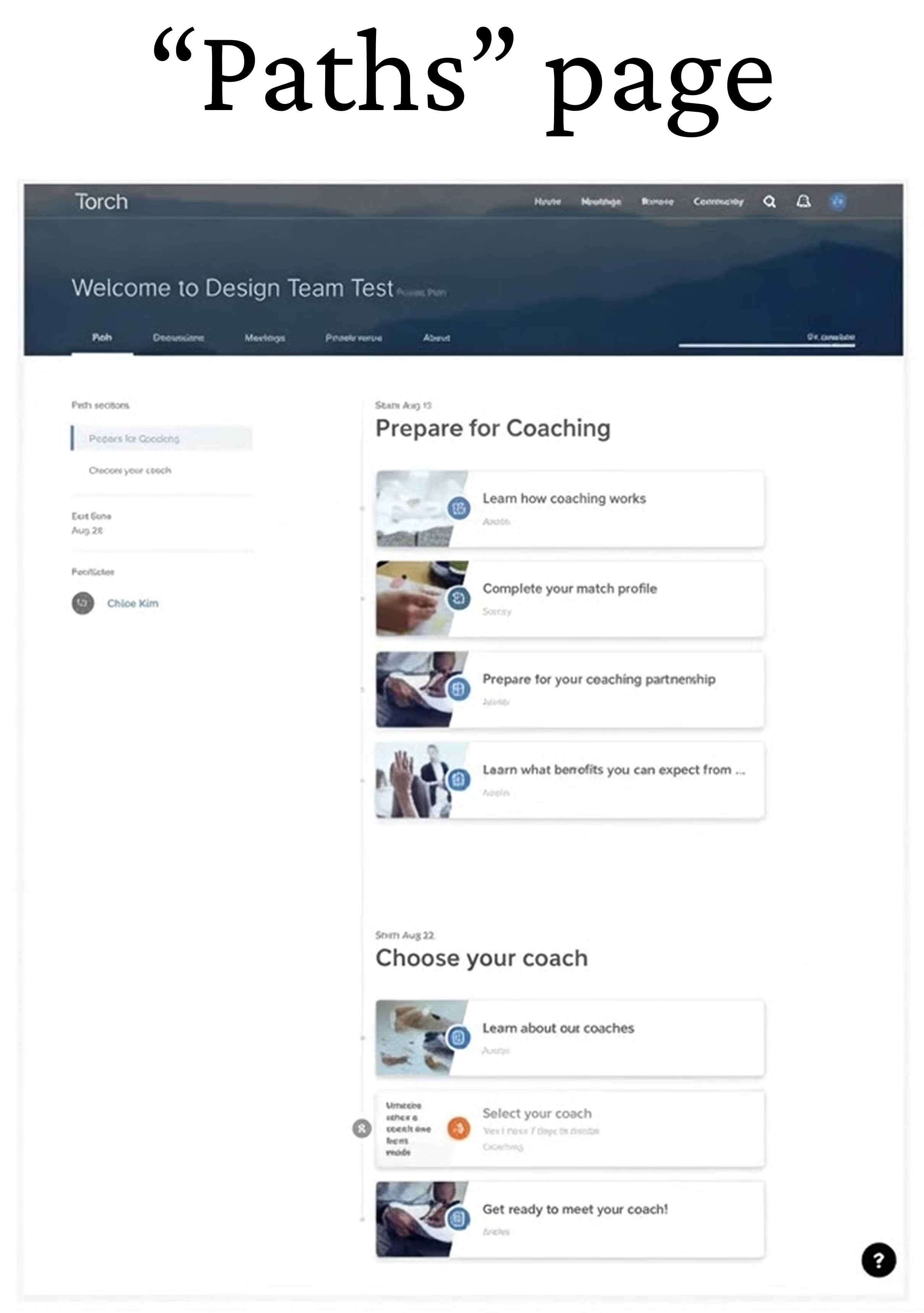
Sign up, then land straight on the “Path” page
Navigation options with no guidance
The match profile, the key action, buried in resources
1–2 weeks to complete, if at all
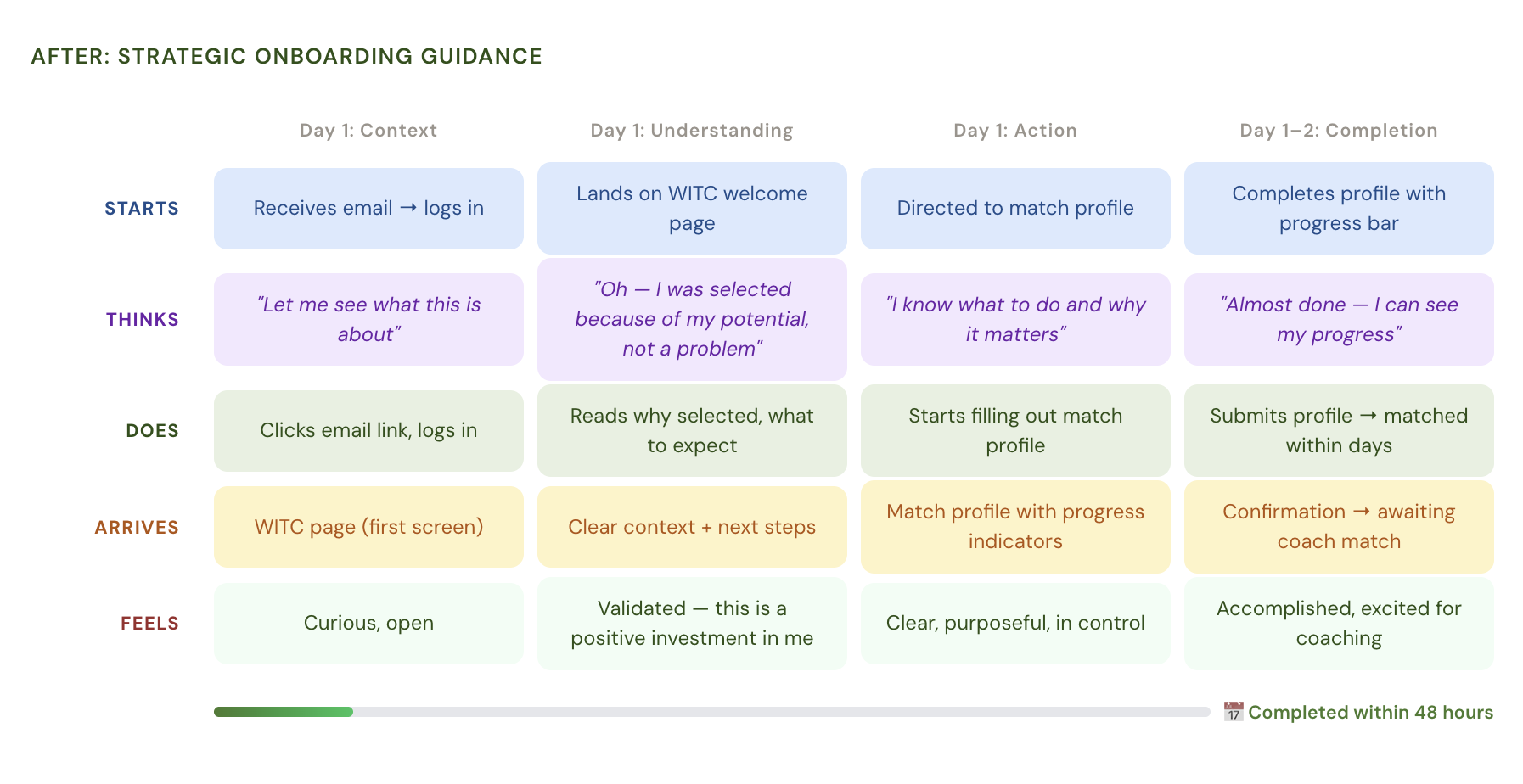
After
Strategic guidance
Sign up, then land on a welcome page
Understand why you were selected and what’s next
Go straight to the match profile, with clear progress
Complete within 48 hours
02
Context · Research
Slow starts undermined Torch’s ROI promise
Torch matched thousands of employees with coaches each year. Delayed launches put ROI and renewals at risk.
The symptom
Coachees took 1–2 weeks to complete their match profile, the action that triggers pairing with a coach.
Leadership impact
“Is Torch fulfilling its core promise to unlock the potential of people, teams, and organizations?” New product leadership saw the problems start at signup.
The key question
How might we accelerate the first critical action and deliver value from day one?
The research
Five critical problems
After reviewing feedback, walking the flows ourselves and synthesizing themes, I presented five problem areas to leadership.
1 · Onboarding (priority)
No guidance for new coachees: the highest-leverage fix.
“Where you’re seeing issues follows exactly what I’ve been hearing from customers and customer-facing teams.”
Lead Designer
“I’m seeing the same issues from cohorts in recent survey feedback.”
Decision
With product and design leadership aligned, I was tasked with redesigning onboarding.
How design drives revenue
From customer behavior to business outcome
1 · The behavior that drives results
Completing the match profile within 48 hours of signup.
Leading
Time to first coaching session
Lagging
Satisfaction at launch
Leading
Engagement throughout the program
Lagging
Contract renewal rates
2 · What stood in the way
Credibility gap
“Why was I selected? Is something wrong with me?”
Impact gap
“What am I supposed to do? Where do I start?”
Hypothesis
Clarity on why they were selected, plus a direct path to the match profile, will move completion from about a week to 48 hours.
3 · How we’d know
48 hrs
match profile completion: the primary outcome
03
Approach
Speed over depth
The constraints
Business
1 month to design, for upcoming cohort launches
Limited engineering capacity
Leadership needed quick wins
Technical
Missing design system components (progress bar, better inputs)
Integration with the matching algorithm
Coordination with email and notifications
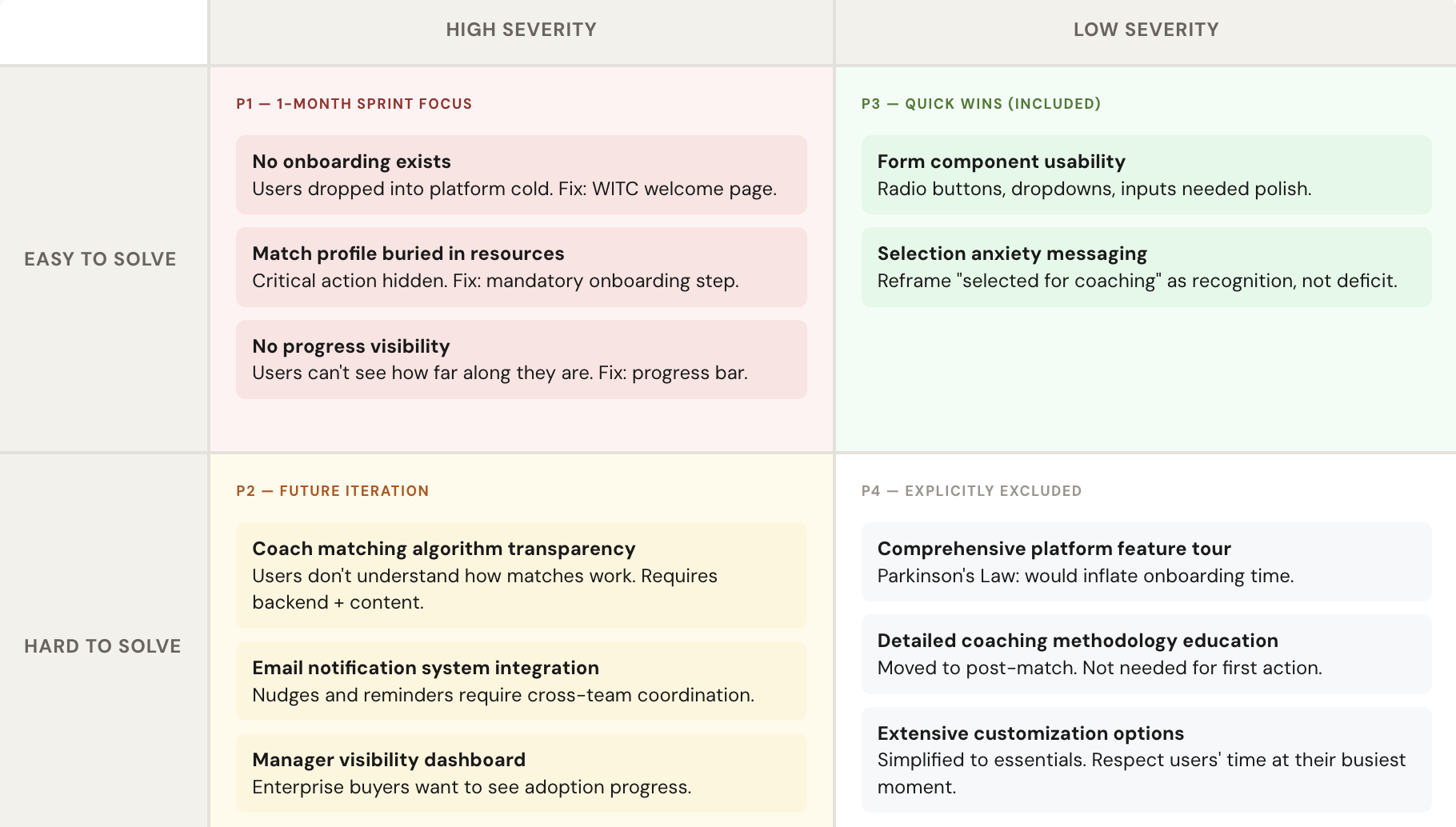
What we prioritized
Understanding selection
Completing the profile
Participants valued getting to coaching fast over exhaustive education, and Parkinson’s Law warned that any task inflates to fill the time available. We respected their busiest moment.
What we left out
Coaching methodology
Moved to after matching
Feature tours
Moved to after onboarding
Customization
Cut to the essentials
The design
From strategy to screens
The goals
User goals
“Help me understand why I was selected”
“Help me take the first step to get matched”
Business goals
Match profile completion within 48 hours
Faster time to first session
Higher satisfaction at launch
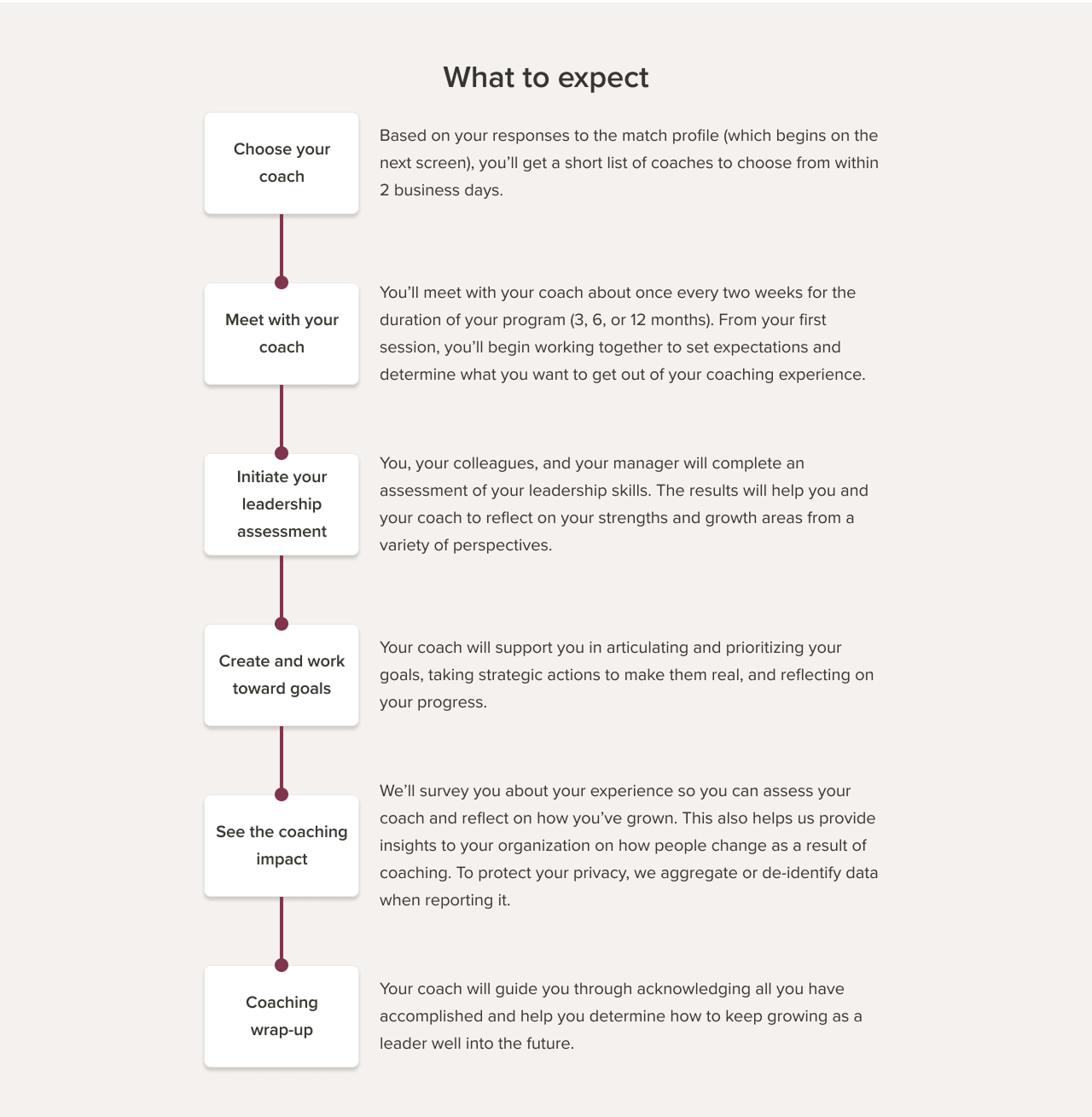
1 · The “What is Torch Coaching” welcome page
Closes the credibility gap.
Why you were selected
→ Recognition of potential, not a deficit
What a coach is
→ Clearer expectations
What to expect
→ Outcomes, not features
Heuristic #10 · Help and documentation
Front-load context instead of relying on discovery.
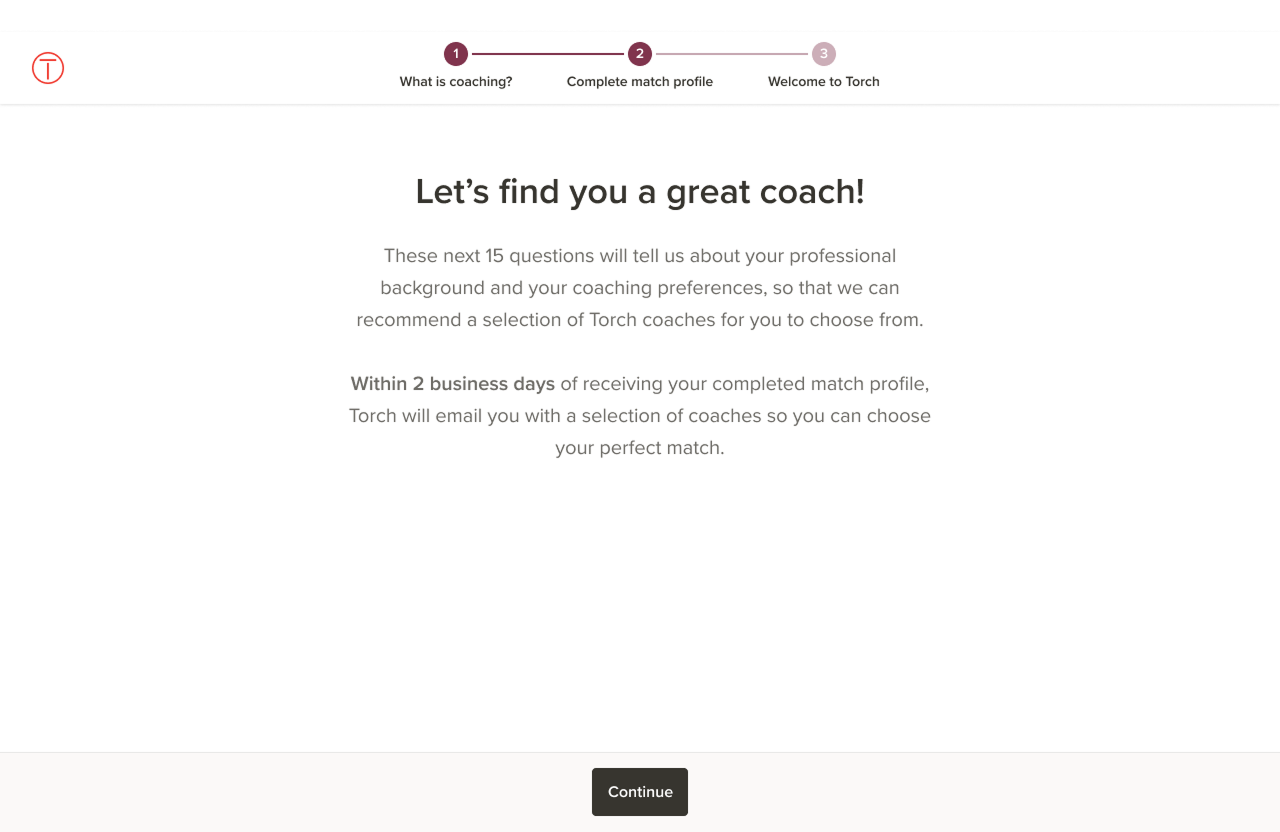
2 · A streamlined match profile
Closes the impact gap. New components built with design and engineering.
Mandatory, not hidden
→ Moved from path resources into onboarding
Progress indicator
→ A new component that cuts cognitive load
The UX principles
Hick’s Law
Fewer choices during onboarding to focus attention.
Heuristic #1 · Visibility of system status
A progress bar shows how close you are.
The collaboration
Three teams, one goal
Customer success
Refined welcome messaging
Tested comprehension with participants
Iterated on tone and clarity
Product
Revised match profile questions with product and data
Tested usability of the new UI
Validated that progress indicators eased anxiety
Engineering
Built new design system components
Met WCAG 2.1 AA
Kept it responsive on mobile and desktop
Final designs
04
Results
Better first impressions protect lifetime value
Strategic design at a key moment creates measurable business outcomes.
Targeted goals
Less launch anxiety for participants and customer success teams
Better first impressions at a critical moment for customer relationships
Differentiation through faster time to coaching
05
Reflections
Respect people’s time at signup
It’s tempting to add onboarding steps that feel valuable, but they don’t always match what people expect. Parkinson’s Law: any task will inflate until all the available time is spent.
So we have to respect and guide people’s time when they first sign up, by understanding what’s on their mind in that moment.
In Torch’s case
Answering why they were selected, what to expect and what to do next, so they could start with a coach right away.